
I have been waiting to publish this blog post until after my scientific research was published…and, well, if you’re reading this…that means my scientific research has been published!!!!
Here’s the link: Exposure to Perfluorooctanoic Acid Perturbs Serotonin Signaling in Maternal Pancreatic Islets and Induces Gestational Diabetes in Mice
This is such an exciting achievement for me for a lot of reasons. For one, I’ve been working on this project for the last 3+ years. I have dedicated so much time and energy to this project, and it feels so surreal to see my images, my graphs, and my words published, and to see my work recognized by others in the field. Having my work published makes all those early mornings, my eight-week stretch of coming into work every single day, and all those long days (often 10+ hours) feel worth it.
Another reason my publication is such an exciting achievement is because it means I have fulfilled one of the main accomplishments necessary to graduate with my PhD! AKA…I can finish soon! In fact, I was so excited that the day after my paper was published, I asked my research advisor whether she would support me scheduling a committee meeting to discuss my readiness to defend. She said yes, and I emailed my committee the next day to start getting that scheduled!
So…this is a HUGE achievement, and I hope that all my friends (or anyone reading this blog post) get to experience the rewarding feeling of publishing their research and seeing their work recognized.
My goal with this blog post is to shed some light on what the process of publishing a scientific manuscript actually looks like. Because, honestly? The process was even longer and more grueling than I could have ever anticipated…and my process was a lot quicker than some other folks I know!!! And I still thought it was long and grueling!
For my readers not involved in research or publishing, here is a brief, yet broad explanation of the publication process.
The first stage is manuscript preparation. This is where you begin putting together a scientifically meaningful story based on your research. You write the experimental methods (what you did to collect your data), the results (what you found), and the discussion (what your findings mean in the context of the broader field and/or human health). You also prepare figures (images and graphs) and tables that demonstrate your data in a clear and accessible way.
There is A LOT of writing and revision during this stage. You might change the order in which you present your data, reframe your research, or even rethink the overall story you want to share. Making graphs and running statistics can take a lot of time!! Importantly, manuscript preparation doesn’t necessarily mean all your experiments are finished. You can (and often should!) begin writing while you’re still collecting data.
Once your manuscript is in good shape, the next step is initial submission. Hopefully, by this point, you have decided which journal you want to submit to based on its scope, audience, and relevance to your research. You also need to ensure that your manuscript, figures, and tables meet the formatting requirements of that particular journal. Some journals also allow you to suggest potential reviewers or indicate reviewers you would prefer not to evaluate your work, but the final decision is up to the journal.
After submission, your manuscript undergoes initial editorial assignment. An editor evaluates whether the paper is appropriate for the journal and whether it should proceed to external peer review. Sometimes, a paper is rejected at this stage without ever being sent to reviewers. This is often referred to as a desk rejection.
If your paper proceeds to peer review, it is sent to experts in the field who evaluate the quality, rigor, and significance of your research. These reviewers provide feedback and recommendations to the editor, who ultimately makes the decision about your manuscript. Environmental Health Perspectives, where I published my paper, has a great online portal to track the progress of your manuscript. I was able to see when my paper had been assigned an editor, when it was out for peer review, when it was awaiting a decision (peer review complete and awaiting the editor’s review), and when a decision had been made.
The editor will then communicate a decision. Common outcomes include rejection, minor revisions, or major revisions. The extent of the requested revisions can vary widely, from relatively minor changes to the manuscript’s wording or figures to much bigger requests, such as conducting additional experiments.
If revisions are requested, you are given a deadline to address the reviewers’ and editor’s comments and resubmit your manuscript. Depending on the extent of the revisions, this could be anywhere from a few days to several months. Your revised manuscript may then go back to the original reviewers for another round of evaluation, or the editor may assess the changes directly. There may be additional rounds of revisions before a final decision is reached.
Eventually, your manuscript will be either accepted or rejected. If it is accepted – yay! If it is rejected, you will likely receive feedback that can help you decide what to do next (e.g., conduct additional experiments, revise the manuscript, or submit to a different journal).
But even acceptance isn’t quite the finish line! After acceptance, your manuscript typically goes through a production process, during which the journal formats the paper and prepares it for publication. You may receive page proofs to review and correct before the final article is published online or in an issue of the journal.
All in all, the publication process can take anywhere from weeks to many months, depending on the journal, the reviewers, the extent of the requested revisions, and how many rounds of review are necessary. It’s a long, and thorough process.
Ok, now, back to me and some words a Knicki from the past wrote:
I wish I had started writing this blogpost at the same time I started writing my scientific manuscript, that way I could have written about the process (and my feelings about it) DURING the process. But, alas, hindsight is always 20/20.
I remember last Summer (2025), my boss telling me and my labmate that writing a paper is a long process, and it will take at least 6 months to publish a paper from the time you start writing it to the time it is published, and so she had encouraged each of us to begin writing our papers, even though neither of us felt like we had the complete data set to actually publish yet. I’ve learned that my boss is usually right about these things, so I abided by her request while continuing to set up experiments that were critical for this paper.
While I do have publications from my time working at the National Cancer Institute, including one on which I am a co-first author…writing this paper felt a lot bigger. For this paper, I prepared every single sample and performed every single experiment. I spent YEARS working on these experiments, optimizing them, improving my technique, troubleshooting different solutions and antibodies, training on different equipment, reading the background…I even earned my Master’s degree proposing this work. All that to say, I’ve invested A LOT of time and effort into this. LITERALLY my blood, sweat, and tears. I’ve lost sleep, I’ve worked 10-14 hour days, I’ve LOST MY WEEKENDS – I truly dedicated so much to this.
So this paper IS a lot bigger to me. It is both the crux and the joy of my existence.
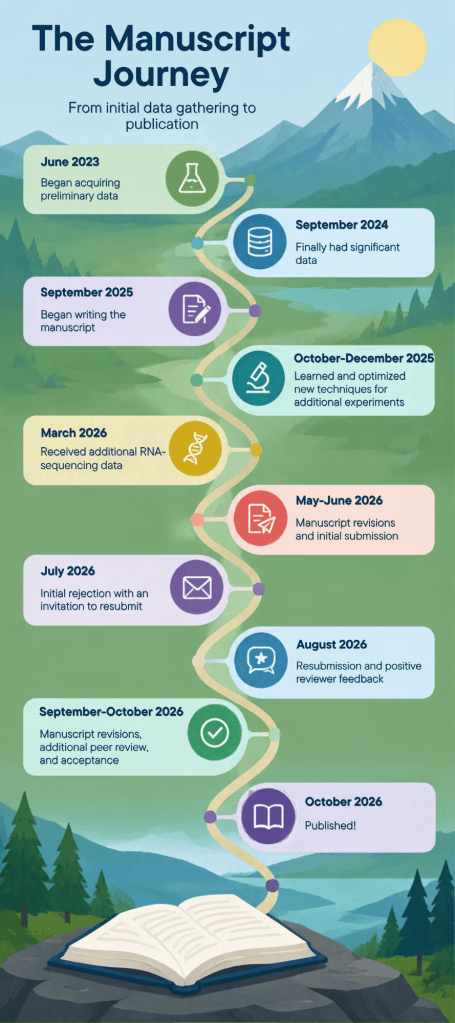
My boss said that it would take at least 6 months to publish a paper from the time you start writing it to the time it is published – my paper was accepted for publication 13 months after I began writing it last September (2025) !!! …13 months!!!!
That may sound like a crazy amount of time…and, to be honest, I don’t disagree 😂 This HAS been a long process…and nobody has felt that more than me.
To be honest, the writing that took place from September 2025-November 2025 felt pretty casual. I knew I didn’t have all the data yet, so I didn’t feel as much pressure to get the writing complete and in “publishing shape” as I did later on in the process.
At the same time, I was working on my rescue experiment, which strengthened the evidence supporting the mechanism we were proposing. I felt like I was making good progress in both my writing and my experiments and felt like I was on track to get this paper submitted by the end of the year (Dec. 2025).
That was until my boss ran into one of my committee members and they discussed my progress…and felt I was pushing this paper out prematurely and should complete an additional experiment that I had previously proposed…
Completing an additional experiment may not sound like that much. Except that this experiment WAS a lot of extra work. This new experiment involved conducting bulk RNA sequencing on pancreatic islets from exposed pregnant mice. In other words…I would be learning how to isolate pancreatic islets and how to extract RNA…after exposing mice for two weeks. Notice I said “learning”. I did not know how to do either of these techniques yet.
So, before I could set up the experiment, I had to troubleshoot and practice. A lot. I began practicing in October 2025, and by December 2025, I was consistently able to obtain healthy samples for downstream analysis. Only then was I able to set up the experiment.
Long story short – at the end of March we had the data from this additional experiment to add to my paper! The challenge? Finding a way to incorporate this new data into the paper I had already developed and writing a more cohesive story.
There were some differing priorities in my lab at the time, so I didn’t get eyes on my paper again until May. Which, mind you, is when I go to the Marine Biological Laboratory in Woods Hole, MA for 2.5 weeks to manage a course…so…I was a bit busy, to say the very least. Oh yeah, and I was also moving into a new apartment at the same time.
May-June was definitely one of the more stressful times of my whole PhD, and maybe some of my life too 😆
We finally submitted the paper in mid-June. And, about one month later – the day after I got home from vacation – we received an email that the paper had been rejected.
Knife to the heart.
I was initially really upset. My confidence was at an all-time low, and I didn’t feel particularly supported during that time either. I remember feeling like I’d already fallen down on the curb, only to be curb stomped afterward.
I had to pull myself back up and look at the review rationally (mind you: this was after I let myself feel things emotionally – which is an important thing to do). I eventually realized that the rejection – with the option to resubmit – provided very reasonable feedback, and that we’d be able to address everything that they asked for.
I thought to myself that the editor must have generally liked the paper if they offered us the opportunity to resubmit, and that them rejecting our paper was actually them giving us the opportunity to add in these data panels that, if missing, may have led to a rejection by peer reviewers with NO option to resubmit. Really, they were helping give us a better chance of receiving a positive review. (That’s a really great editor!!)
We resubmitted the paper just 3 weeks after that initial rejection, and then about 1 month later…we received those very positive reviews!!! (A reminder that sometimes rejection really is just redirection…and not something entirely negative).
We were given just ten days to submit our revisions – those 10 days were incredibly stressful for me…I’ve never worked harder in my life or had worse tummy aches!
And then the waiting began again…
3.5 weeks under peer-review…
2 weeks awaiting decision by the editor…
During these 5.5 weeks, I kept checking the portal for my paper…but covering my eyes and barely looking because I was scared of seeing what the decision would be – that initial rejection truly rocked me.
I kept trying to believe that the decisions would be favorable…and, logically, given the first round of reviews, …it should be?
I felt so anxious, yet so hopeful. I put a sticky note on my computer that said “YOU WILL GET GOOD NEWS THIS WEEK.” I bought a bracelet with Mexican Onyx, which is associated with confidence and strength, grounding and balance, and motivation – things I definitely needed to get me through.
(Hey, it’s present-day Knicki again, no longer a Knicki of the past)
And then, finally, we received the email that they were preparing to accept my paper.
PHEW!!! Huge relief. And a lot of pride too.
I thought back to a joke one of my graduate school friends made once, poking fun at the common phrase in academia “Publish or perish.” This phrase reflects the belief that, in academia, if you don’t publish papers, you (or your career) will perish. The reality of publishing? You perish (or at least your soul does) while you publish 😆
I have mad respect for people who choose to do this for their career – though I look forward to a time in my life when I don’t feel so, so, so entirely stressed about the decision of whether or not my paper will be published and what it means for my PhD timeline or career prospects.
So, what did I learn from this experience?
For one, when trying to publish a paper, start writing earlier than you think you need to. You don’t need to have every single experiment completed before you start putting your story together. In fact, starting early can help you identify gaps in your data and anticipate experiments that reviewers may request to strengthen your manuscript. The process is going to take a long time no matter what – don’t make it take any longer by being unprepared.
I’d also say to prepare yourself for the fact that the process is rarely linear. You might think you’re one experiment away from submission, only to realize that you need another experiment, another round of revisions, or an entirely different way of presenting your data. You might receive a rejection. You might spend weeks waiting for an editor’s decision. And you might find yourself questioning your work along the way.
But none of that necessarily means your research isn’t good or that you’re not a good scientist. Rejection and revision are part of scientific publishing, and learning how to navigate them is part of becoming an independent researcher.
Finally, give yourself some grace. Publishing a manuscript is a HUGE undertaking, especially when you’re also juggling experiments, coursework, conferences, teaching, and all the other responsibilities that come with graduate school. Celebrate the little milestones along the way, too, because there are a LOT of them.
And remember, the timeline I described is just my experience. Every manuscript, journal, and peer-review process is different. Some papers move through the process much faster, while others take considerably longer.
Onto better things…(and still more research)


Leave a Reply